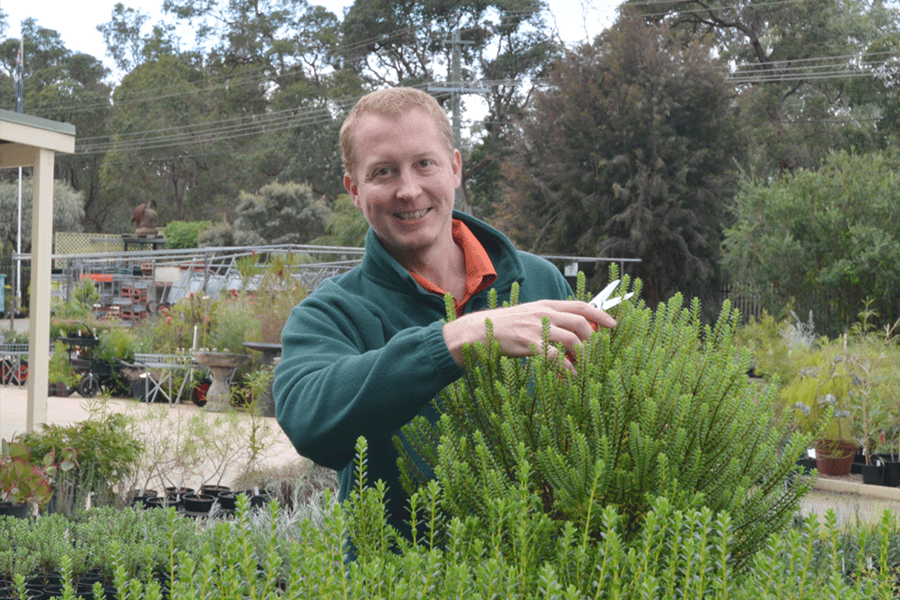
The art of pruning in the Australian garden Who feels confused about pruning? Who neglects pruning? Then please read on because it really isn’t hard at all. I hope to demystify pruning and give you the confidence to really take control of your garden. Most plants look better with a little pruning and it can make a huge difference to the look of your garden (and it’s free!) The technical side is quite easy – you’ll find some pointers below. I think it’s more the artistic side we need to think about. Once you are comfortable with pruning you’ll find the creative expression extremely satisfying. To me it’s the most fun part of gardening. Are Australian Plants any Different? Generally, if you are comfortable pruning exotics, then follow the same principles for Australian plants. Some Australian plants though: • Are naturally open and require pruning if you want a dense bushy plant. • Will allow some sections to die in very dry conditions (best removed). • Will handle very hard pruning (an adaptation to bushfires). Aesthetically, Australian plants can be quite different. It’s not merely a soft lush green look. Some have interesting trunks, beautiful bark, and striking shapes can be featured. Think about emphasising these. Do I need to prune? What do I want to achieve by pruning this plant? If you can’t answer this then put down your secateurs! Think about how you would like the plant to look in the future. Remember that some plants have a great natural shape and really don’t require pruning, eg, Baeckea virgata ‘Miniature’, Acacia ‘Honey Bun’. Knowing your purpose will tell you how to do it.
Pruning basic guidelines
• Start young with formative pruning. • Begin by removing the 3 “d”s: dead, diseased and damaged material. • Timing. Generally, after flowering. Heavy pruning is best done in the milder seasons. • How much? Consider your purpose! As hard as you like provided some green shoots remain. Young healthy plants may be pruned harder than old stressed plants. Slow growing plants are best pruned less. Some will respond to cutting very hard into old wood, eg, callistemons, calothamnus, tropical grevilleas. Some will not tolerate this as branches may die back, eg, acacia, westringia. • What shape? It’s up to you! In many cases a curved “bun” works well. (Bottom is slightly larger to allow light to reach lower branches.) Straight lines are usually best avoided unless hedging or topiary. Please don’t turn everything into little buns though! (This can be the hallmark of unimaginative “professional” gardeners). Try to have a variety of shapes. Be creative here. Look at the natural shape of the plant that you may be able to enhance, eg, pendulous, horizontal, mallee, Bonsai – like. Use your feet during pruning to walk back and have a look at progress. (You can’t get an idea of the shape standing right over the plant.) • Pruning can be ‘invisible’. In some cases, you can cut into the plant leaving a soft natural look. You may be able to remove substantial material but leave the plant looking unpruned. • Grass / strappy plants. Remove dead or damaged leaves to the ground. Avoid cut blunt ends. Some can be cut to the ground to regenerate, eg, lomandra, kangaroo paw. • Use the right tool. Tools should be sharp clean and big enough to cut cleanly. Secateurs are delicate and selective. Hedge shears are not selective and give a more “clipped” formal look. • Large branches. First cut must be well back from the trunk to avoid tearing. Then avoid cutting flush with trunk, rather leave a small stub or collar. Inspired to prune? Great! Well take what you’ve read as guidelines only. It’s your garden so try whatever you like. Be bold. Experiment. Observe what happens. You will soon become an expert this way. Draw inspiration from natural and artificial environments. (Our gardens have to fit into both.) Be diligent with pruning and enjoy a special kind of involvement with your garden : as an artist!